Posts

Constrained MDPs and the reward hypothesis

It's been a looong ago that I posted on this blog. But this should not mean the blog is dead. Slow and steady wins the race, right? Anyhow, I am back and today I want to write about constrained Markovian Decision Process (CMDPs). The post is prompted by a recent visit of Eugene Feinberg , a pioneer of CMDPs, of our department, and also by a growing interest in CMPDs in the RL community (see this , this , or this paper). For impatient readers, a CMDP is like an MDP except that there are multiple reward functions, one of which is used to set the optimization objective, while the others are used to restrict what policies can do. Now, it seems to me that more often than not the problems we want to solve are easiest to specify using multiple objectives (in fact, this is a borderline tautology!). An example, which given our current sad situation is hard to escape, is deciding what interventions a government should apply to limit the spread of a virus while maintaining economic ...
Student Response Systems

There are plenty Student Response Systems (SRSs) out there. Which one to choose? This brief document summarizes what I have found on the web before the Fall of 2012. Radio communication-based systems The systems differ in a few characteristics. The first is what type of devices the students can use. Classical, iClicker like systems require the student buy a device which communicates with a receiver that the teacher should possess. Since our school uses iClickers, let me focus on them. The overall cost of first generation iClickers is $10/device, assuming the student sells back the device to the bookstore (which they can). This is not a major cost but who likes to pay when you don’t have to? The first limitation of iClicker-like systems is that they are bound to the smart classrooms and the computers there. Thus, if you are like me and use your own computer for projection, you will need to switch between screens to show the results of a poll. This makes the use of iCli...

Approximating inverse covariance matrices

Image
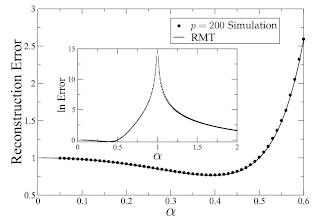
Phew, the last time I have posted an entry to my blog was a loong time ago.. Not that there was nothing interesting to blog about, just I always delayed things. (Btw, google changed the template which eliminated the rendering of the latex formulae, not happy.. Luckily, I could change back the template..) Now, as the actual contents: I have just read the PAMI paper " Accuracy of Pseudo-Inverse Covariance Learning-A Random Matrix Theory Analysis " by D Hoyle (IEEE T. PAMI, 2011 vol. 33 (7) pp. 1470--1481). The paper is about pseudo-inverse covariance matrices and their analysis based on random matrix theory analysis and I can say I enjoyed this paper quite a lot. In short, the author's point is this: Let $d,n>0$ be integers. Let $\hat{C}$ be the sample covariance matrix of some iid data $X_1,\ldots,X_n\in \mathbb{R}^d$ based on $n$ datapoints and let $C$ be the population covariance matrix (i.e., $\hat{C}=\mathbb{E}[X_1 X_1^\top]$). Assume that $d,n\rightarrow \in...

Brains, Minds and Machines

Former UofA student, Alborz , shared a link to a video recording of a recent MIT150 symposium on Brains, Minds and Machines on facebook. I watched the video yesterday (guess what, I need to mark 40 something finals, hehe:)). I wrote a comment back to Alborz on facebook and then I thought, why not make this a blog post? So, here it goes, edited, expanded. Warning: Spoilers ahead and the summary will be biased. Anyhow.. The title of the panel was: " The Golden Age — A Look at the Original Roots of Artificial Intelligence, Cognitive Science, and Neuroscience 
" and the panelist were Emilio Bizzi, Sydney Brenner, Noam Chomsky, Marvin Minsky, Barbara H. Partee and Patrick H. Winston. The panel was moderated by Steven Pinker who started with a 20-30 minute introduction. Once done with this each of the panelist delivered a little speech and at the end there were like two questions asked by Pinker. My heroes in the panel were Minsky and Winston . They rocked! Minsky almost fell as...

Useful latex/svn tools (merge, clean, svn, diff)

This blog is about some tools that I have developed (and yet another one that I have downloaded) which help me to streamline my latex work cycle. I make the tools available, hoping that other people will find them useful. However, they are admittedly limited (more about this) and as usual for free stuff they come with zero guarantee. Use them at your own risk. The first little tool is for creating a cleaned up file before submitting it to a publisher who asks for source files. I call it ltxclean.pl , it is developed in Perl. It can be downloaded from here . The functionality is (1) to remove latex comments (2) to remove \todo{} commands (3) to merge files included from a main file into the main file (4) to merge the bbl file into the same main file If you make the tool executable (chmod a+x ltxclean.pl), you can use it like this: $ ltxclean.pl main.tex > cleaned.tex How does this work? The tool reads in the source tex file, processes it line by line and produces some output to the ...

I can run Matlab on my Mac again!

After much struggling today I managed to make Matlab run again my Mac. The major problem was that Matlab complained about that I have the wrong version of X11 installed on my system and it won't start. As I have finished teaching today for the semester, I thought that I am going to celebrate this by resolving this issue which I was struggling with for a year or so by now. On the internet you will see a lot of advice on what to do, and as they say, the truth is indeed out there, however, it is not so easy to find. In a nutshell what seems to happen is this: Why Matlab does not start when other applications do start (say, Gimp, Gnuplot using X11, etc.). Matlab seems to make the assumption that the X11 libraries are located at /usr/X11/lib and it sticks to this assumption no matter how your system is configured . I use XQuartz and macports' X11 and they put stuff elsewhere. I had some legacy code sitting in /usr/X11/, which I did not use. It was a remainder of some version of X11...

Djvu vs. Pdf

Long blog again, so here is the executive summary : Djvu files are typically smaller than Pdf files. Why? Can we further compress pdf files? Yes, we can, but the current best solution has limitations. And you can forget all "advanced" commercial solutions. They are not as good as a free solution. Introduction DJVU is a proprietary file format by LizardTech. Incidentally, it was invented by some machine learning researchers, Yann LeCun , Léon Bottou , Patrick Haffner and the image compression researcher Paul G. Howard at AT&T back in 1996. The DJVULibre library provides a free implementation, but is GPLd and hence is not suitable for certain commercial softwares, like Papers , which I am using to organize my electronic paper collection. Hence, Papers, might not support djvu in the near future (the authors of Papers do not want to make it free, and, well, this is their software, their call). Djvu files can converted to Pdf files using ddjvu , a command line tool which i...

Keynote vs. Powerpoint vs. Beamer

A few days ago I decided to give Keynote , Apple's presentation software, a try (part of iWork '09). Beforehand I used MS Powerpoint 2003, Impress from NeoOffice 3.0 (OpenOffice's native Mac version) and LaTeX with beamer . Here is a comparison of the ups and downs of these software, mainly to remind myself when I will reconsider my choice in half a year and also to help people decide what to use for their presentation. Comments, suggestions, critics are absolutely welcome, as usual. Btw, while preparing this note I have learned that go-oo.org has a native Mac Aqua version of OpenOffice. Maybe I will try it some day and update the post. It would also be good to include a recent version of Powerpoint in the comparison. Stability Keynote: Excellent After a few days of usage, so take this statement with a grain of salt.. MS Powerpoint 2003: Excellent Impress: Poor Save your work very often Beamer: Excellent Creating visually appealing slides, graphics on slides Keynote: Ex...